Label: CBS SONY (Original:COLUMBIA)
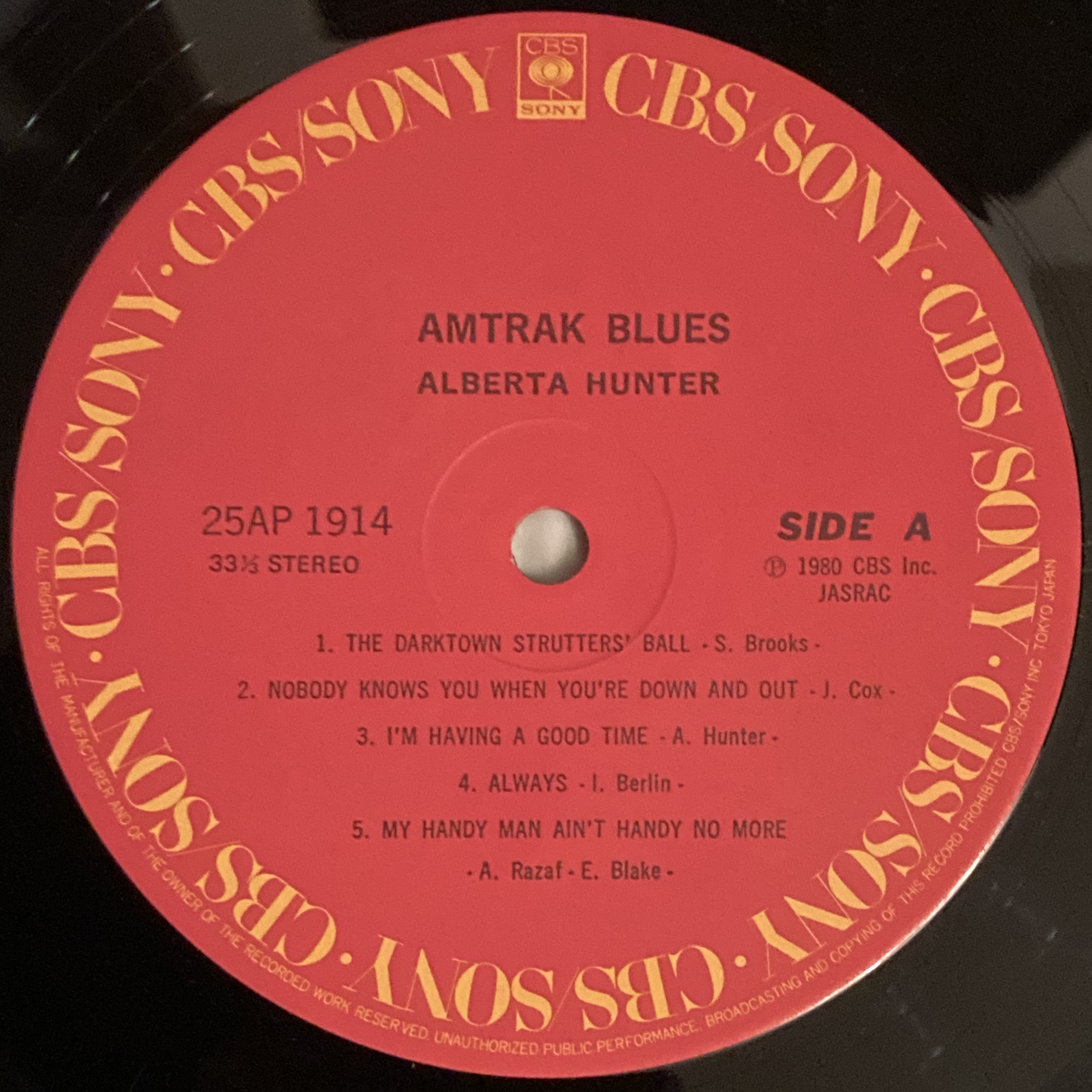
No.: 25AP 1914
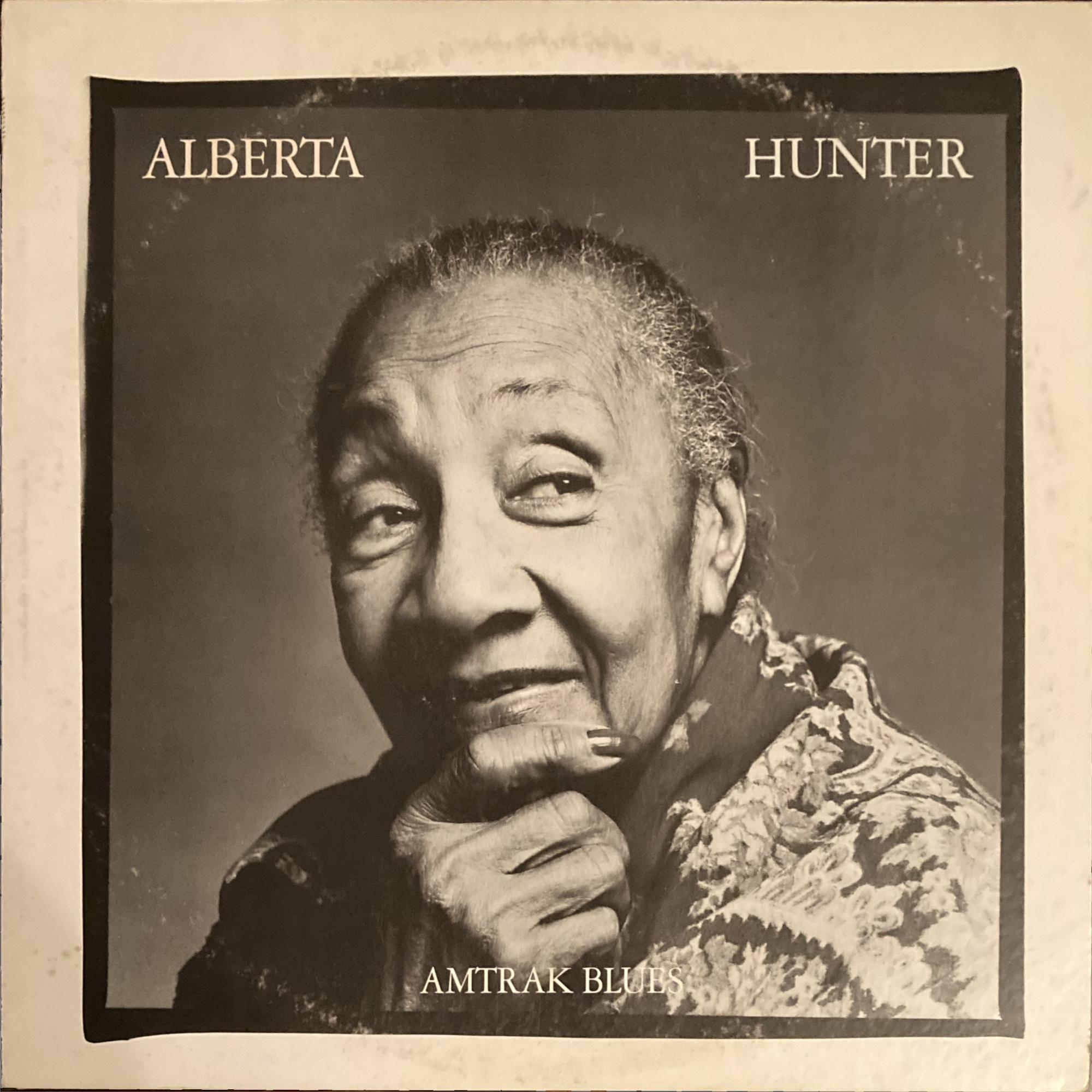
Title: AMTRAK BLUES
Musician: ALBERTA HUNTER
Released:1980
Stereo
Cover address:
Coating無し
Groove Guard
Label Side-A
Red Background
Black Letter
Address:
Deep Groove無し
Dead Wax Info: 25AP-1914A1, I A 2 *, JIS
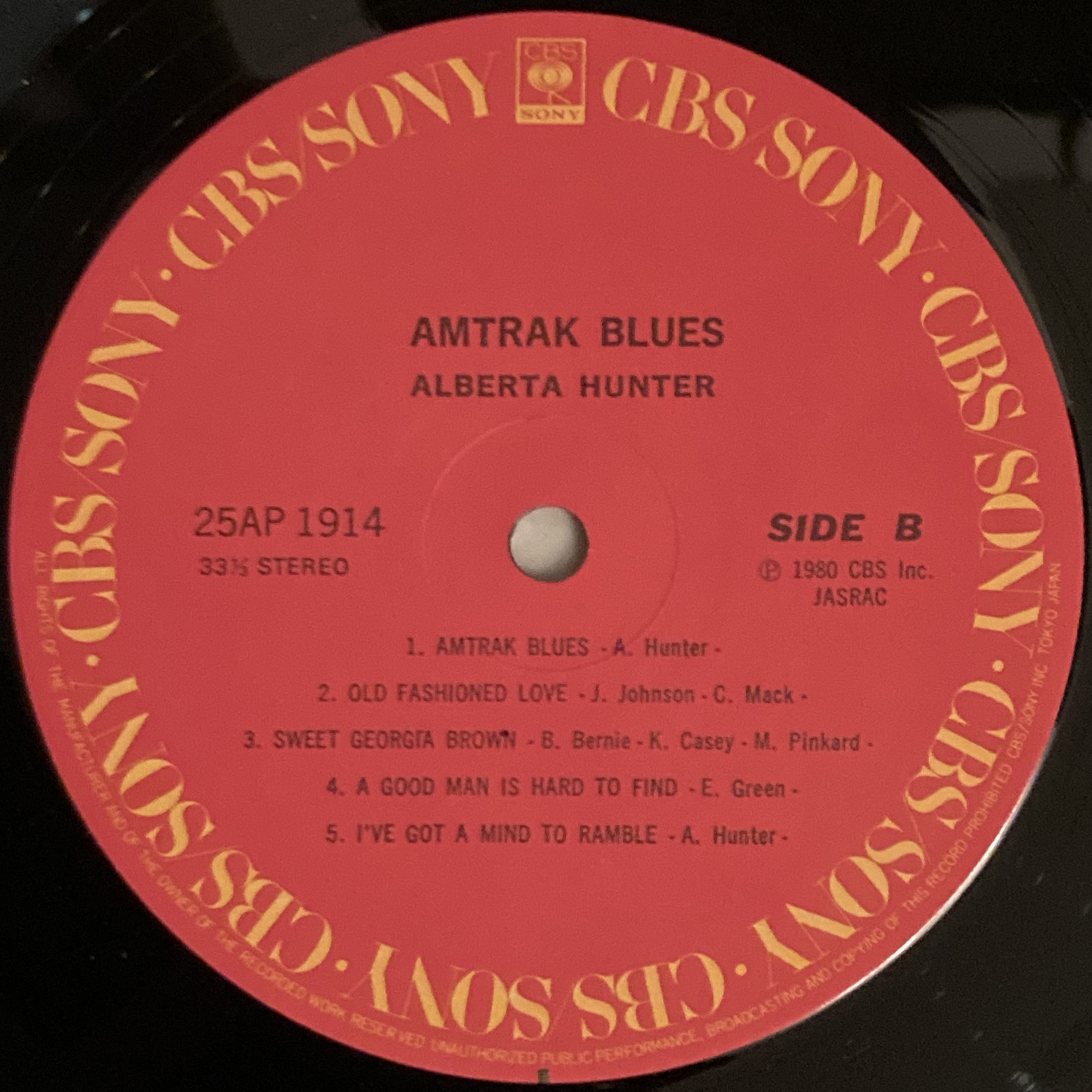
Label Side-B
Red Background
Black Letter
Address:
Deep Groove無し
Dead Wax Info: 25AP-1914B1, I A 1
Personnel-
Vocals: Alberta Hunter
Tracks-
Side-A
1) The Darktown Strutters’ Ball 5’20”
2) Nobody Knows You When You’re Down and Out 3’48”
3) I’m Having a Good Time 2’35”
4) Always 3’41”
5) My Handy Man ain’t Handy no More 3’45”
Side-B
1) Amtrak Blues 3’21”
2) Old Fashioned Love 4’12”
3) Sweet Georgia Brown 4’10”
4) A Good Man is Hard to Find 3’56”
5) I’ve Got a Mind to Ramble 4’13”
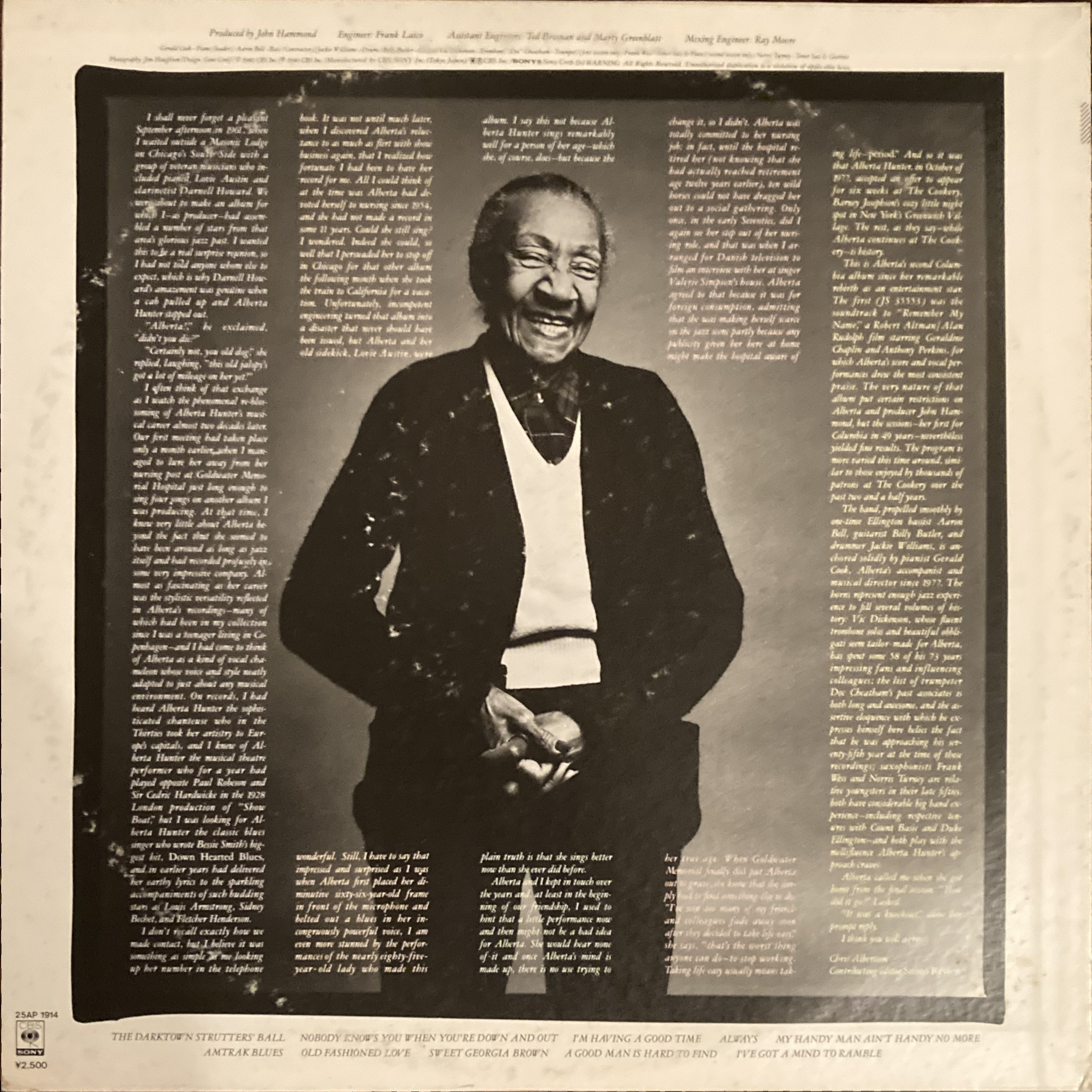
<裏ジャケ原文>
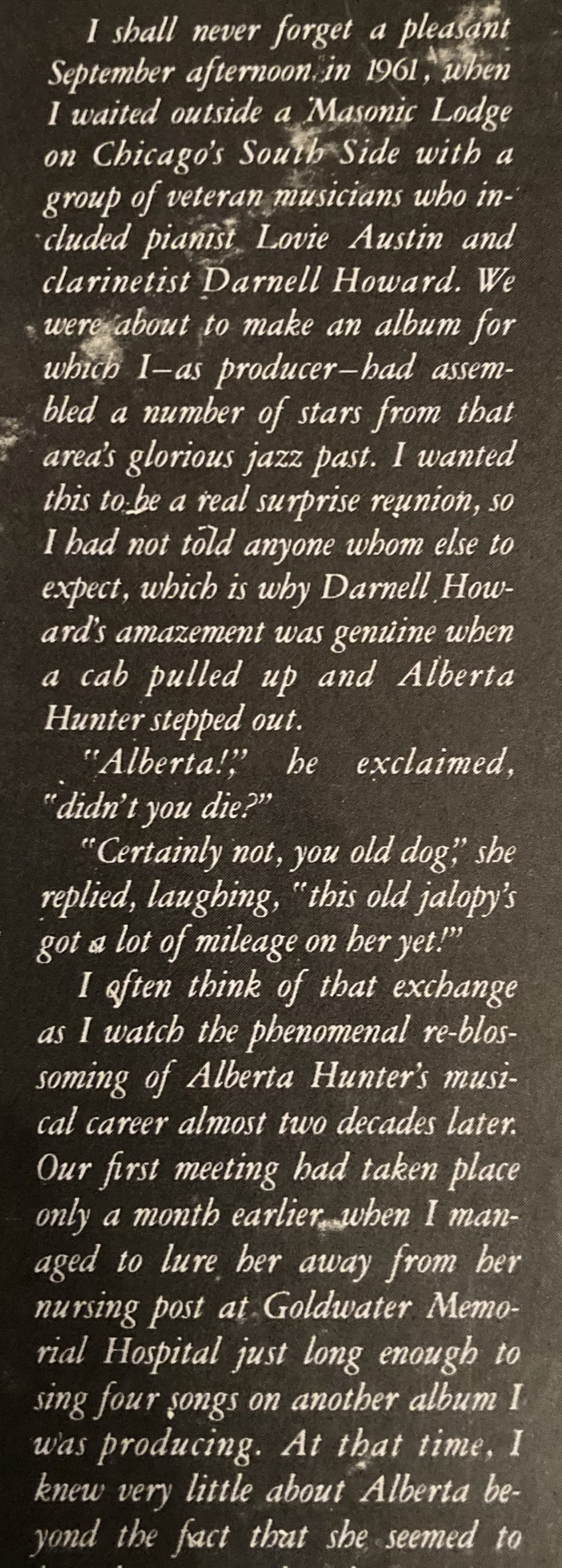
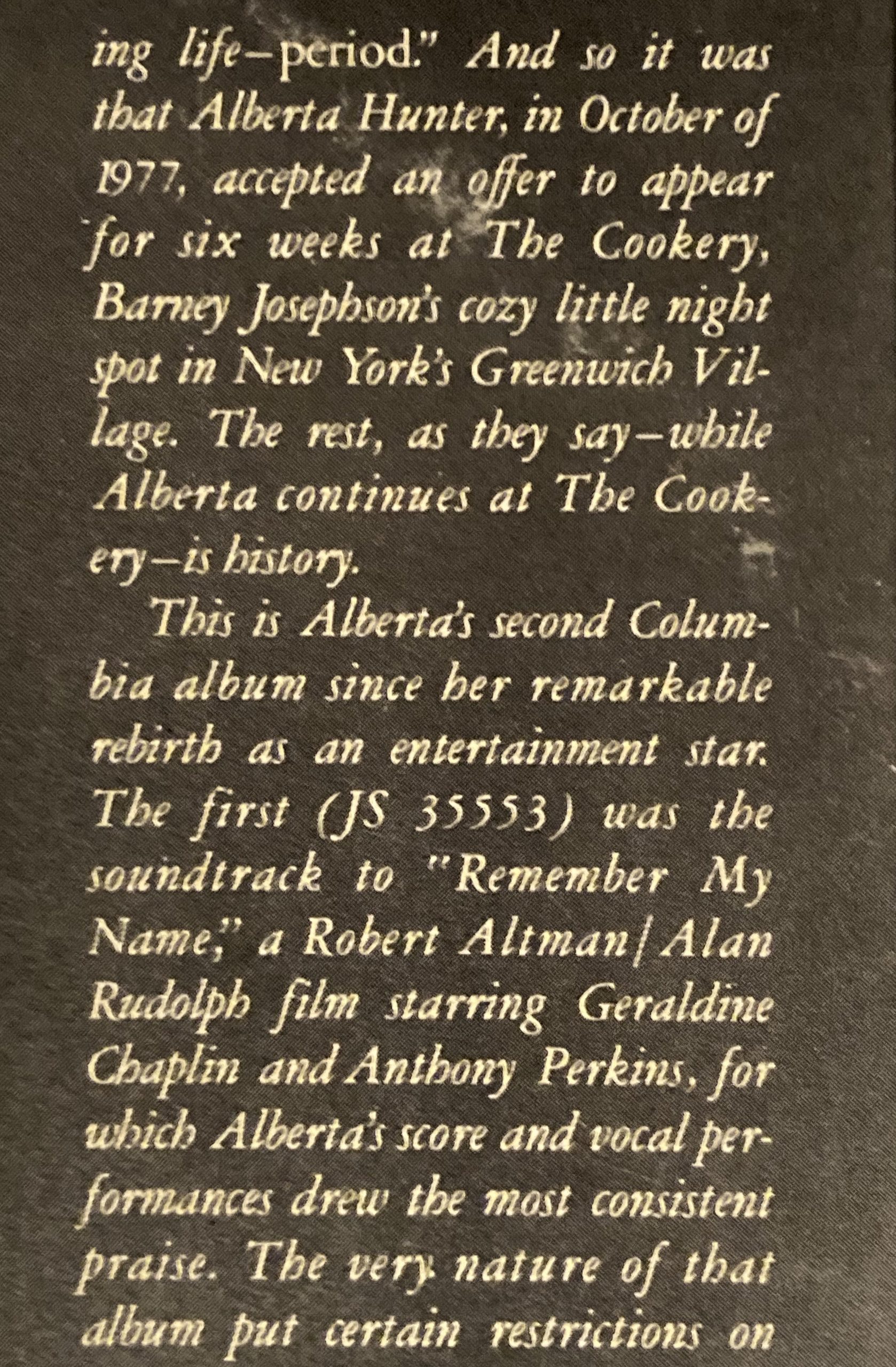
I shall never forget a pleasant September afternoon in 1961, when I waited outside a Masonic Lodge on Chicago’s South Side with a group of veteran musicians who in- cluded pianist Lovie Austin and clarinetist Darnell Howard. We were about to make an album for which 1-as producer-had assem- bled a number of stars from that area’s glorious jazz past. I wanted this to be a real surprise reunion, so I had not told anyone whom else to expect, which is why Darnell How- ard’s amazement was genuine when a cab pulled up and Alberta Hunter stepped out.
“Alberta!” he exclaimed, “didn’t you die?”
“Certainly not, you old dog” she replied, laughing, “this old jalopy’s got a lot of mileage on her yet!”
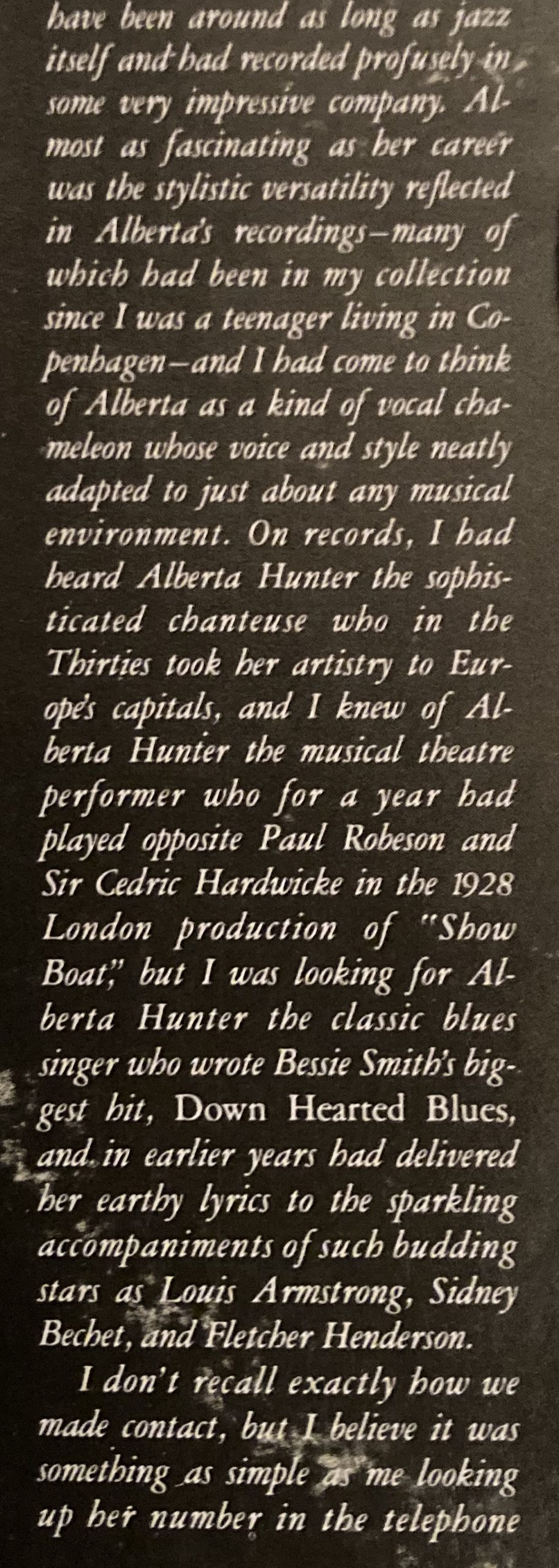
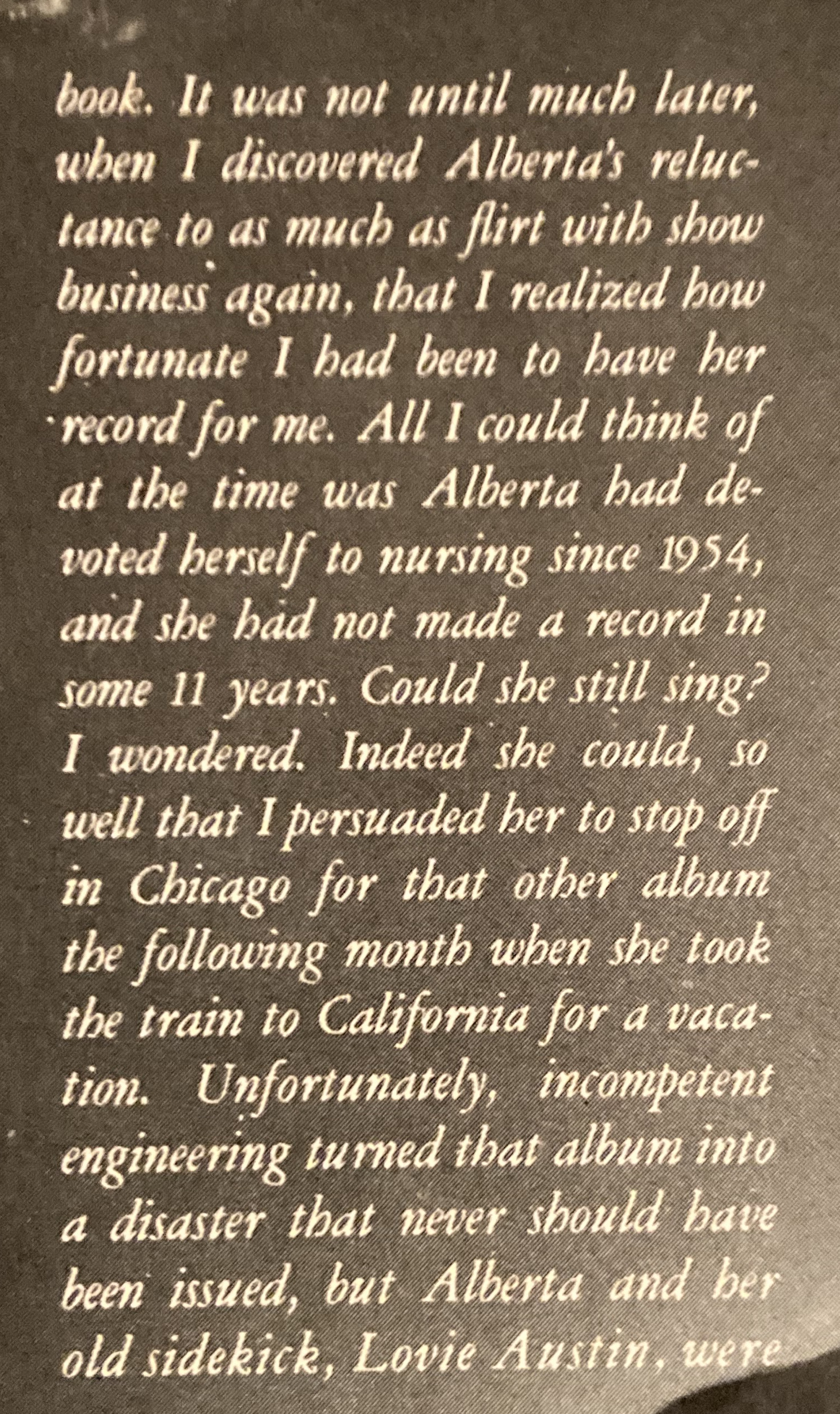
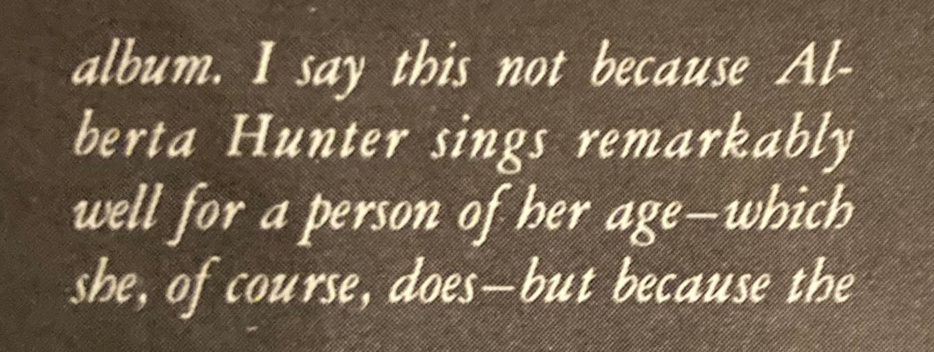
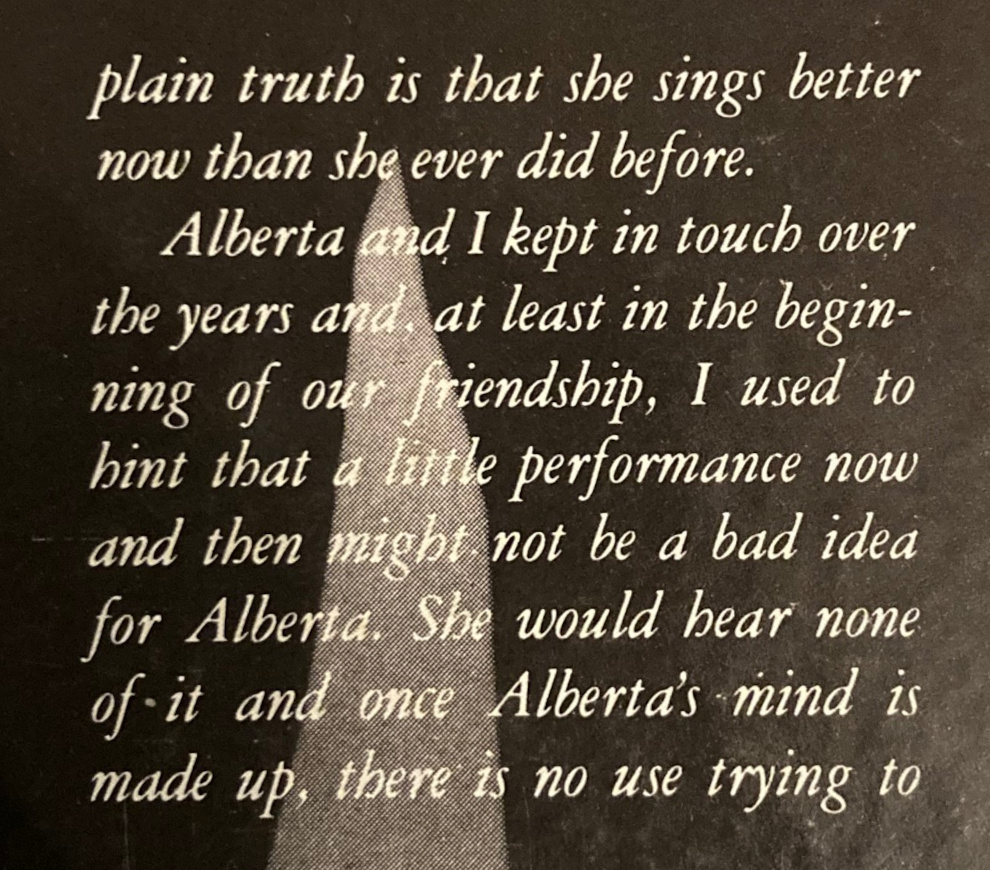
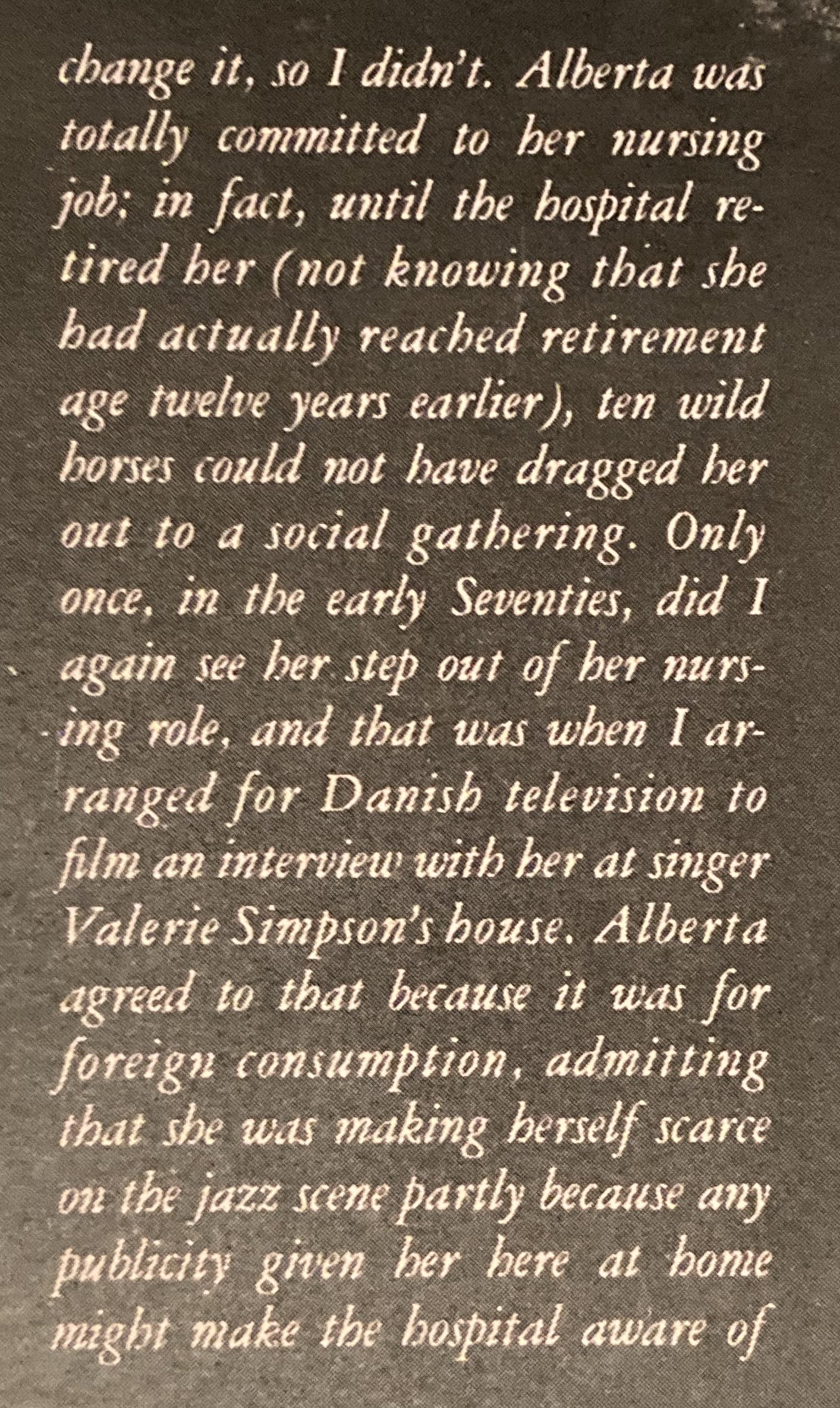
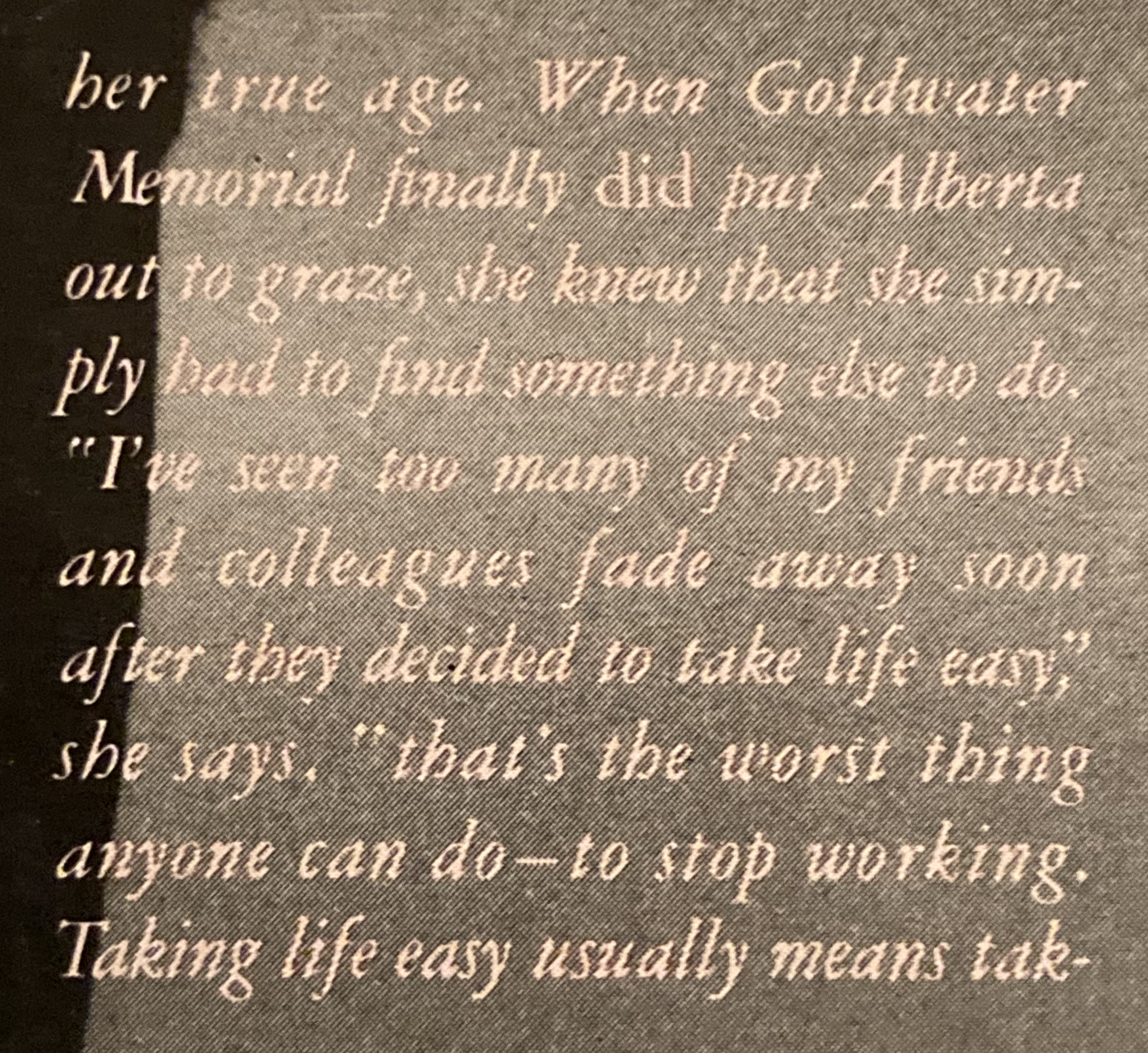
I often think of that exchange as I watch the phenomenal re-blos- soming of Alberta Hunter’s musi cal career almost two decades later. Our first meeting had taken place only a month earlier when I man- aged to lure her away from her nursing post at Goldwater Memo- rial Hospital just long enough to sing four songs on another album I was producing. At that time, I knew very little about Alberta be- yond the fact that she seemed to have been around as long as jazz itself and had recorded profusely in, some very impressive company. Al- most as fascinating as her career was the stylistic versatility reflected in Alberta’s recordings-many of which had been in my collection since I was a teenager living in Co- penhagen-and I had come to think of Alberta as a kind of vocal cha- meleon whose voice and style neatly adapted to just about any musical environment. On records, I had beard Alberta Hunter the sophis- ticated chanteuse who in the Thirties took her artistry to Eur- ope’s capitals, and I knew of Al- berta Hunter the musical theatre performer who for a year had played opposite Paul Robeson and Sir Cedric Hardwicke in the 1928 London production of “Show Boat, but I was looking for Al- berta Hunter the classic blues singer who wrote Bessie Smith’s big- gest hit, Down Hearted Blues, and in earlier years had delivered her earthy lyrics to the sparkling accompaniments of such budding stars as Louis Armstrong, Sidney Bechet, and Fletcher Henderson. I don’t recall exactly how we made contact, but I believe it was something as simple as me looking up her number in the telephone book. It was not until much later, when I discovered Alberta’s reluc- tance to as much as flirt with show business again, that I realized how fortunate I had been to have her record for me. All I could think of at the time was Alberta had de- voted herself to nursing since 1954, and she had not made a record in some 11 years. Could she still sing? I wondered. Indeed she could, so well that I persuaded her to stop off in Chicago for that other album the following month when she took the train to California for a vaca- tion. Unfortunately, incompetent engineering turned that album into a disaster that never should have been issued, but Alberta and ber old sidekick, Lovie Austin, were wonderful. Still, I have to say that impressed and surprised as I was when Alberta first placed her di- minutive sixty-six-year-old frame in front of the microphone and belted out a blues in her in- congruously powerful voice, I am even more stunned by the perfor mances of the nearly eighty-five- year-old lady who made this album. I say this not because Al- berta Hunter sings remarkably well for a person of her age-which she, of course, does-but because the plain truth is that she sings better now than she ever did before. Alberta and I kept in touch over the years and at least in the begin- ning of our friendship, I used to hint that a little performance now and then might not be a bad idea for Alberta. She would hear none. of it and once Alberta’s mind is made up, there is no use trying to change it, so I didn’t. Alberta was totally committed to her nursing job; in fact, until the hospital re- tired her (not knowing that she had actually reached retirement age twelve years earlier), ten wild horses could not have dragged her out to a social gathering. Only once, in the early Seventies, did I again see her step out of her nurs- ing role, and that was when I ar- ranged for Danish television to film an interview with her at singer Valerie Simpson’s house. Alberta agreed to that because it was for foreign consumption, admitting that she was making herself scarce on the jazz scene partly because any publicity given her here at home might make the hospital aware of her true age. When Goldwater Memorial finally did put Alberta out to graze, she knew that she simply had to find something else to do.
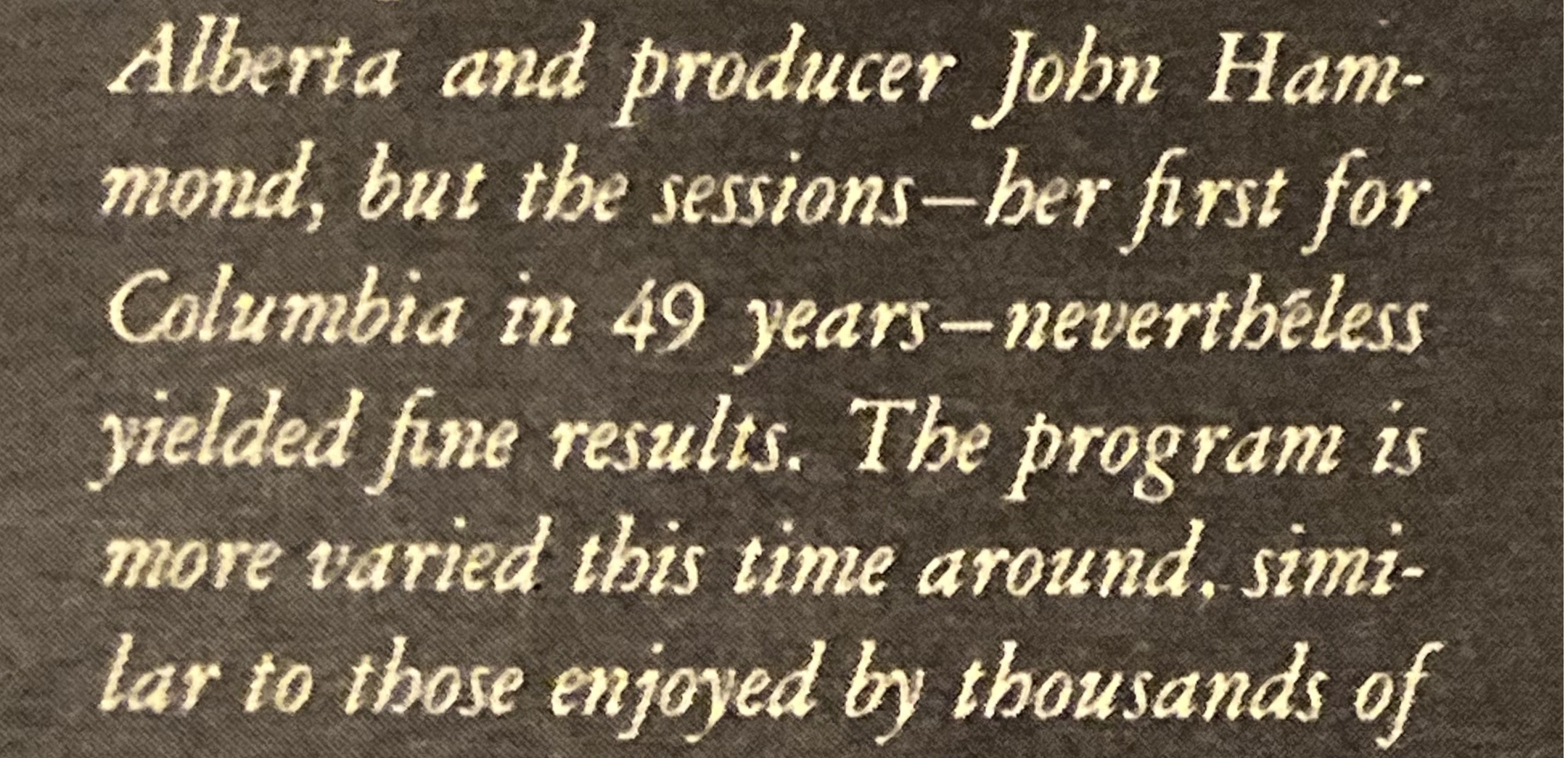
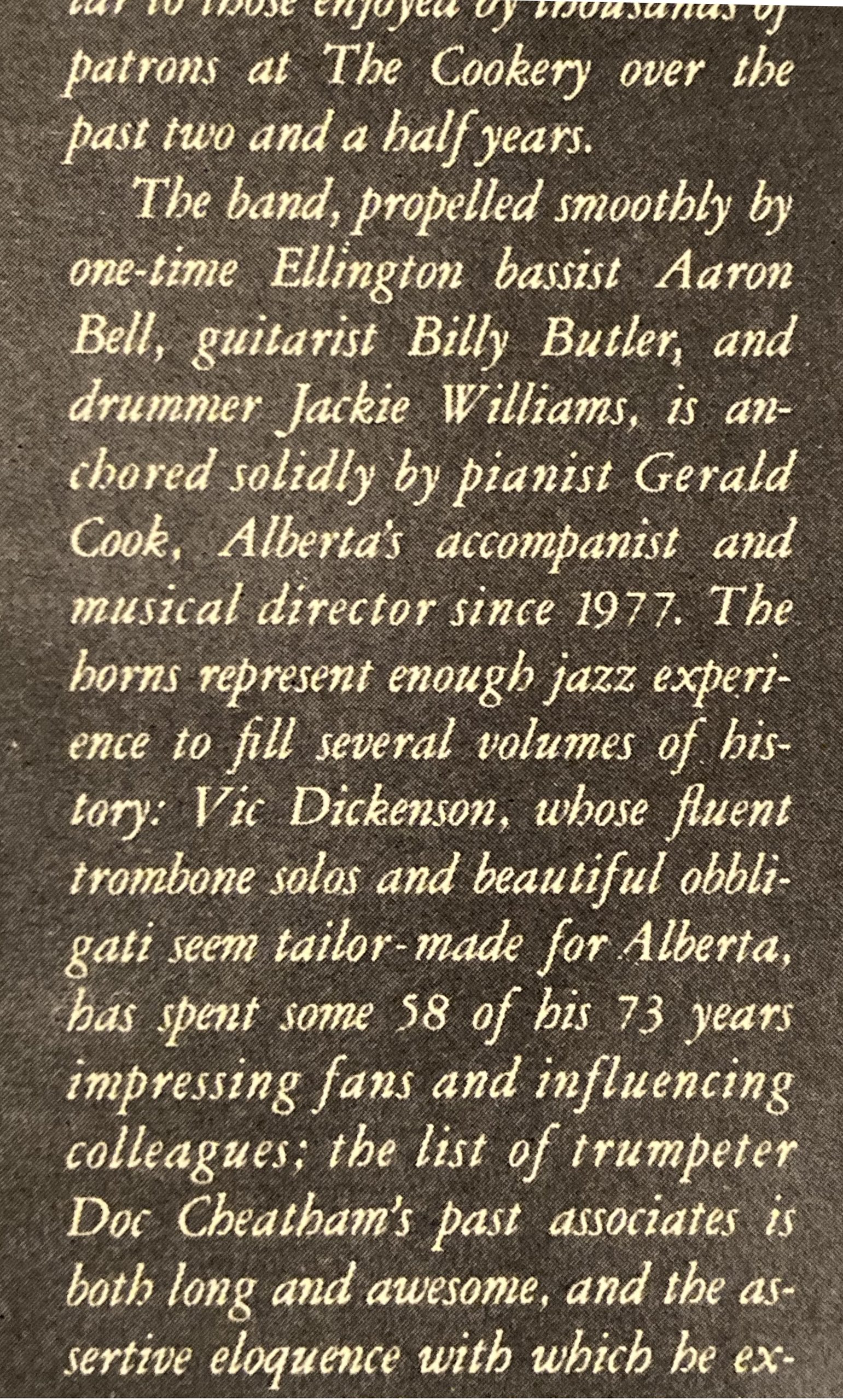
“I’ve seen too many of my friends and colleagues fade away soon after they decided to take life easy, she says, “that’s the worst thing anyone can do-to stop working. Taking life easy usually means taking life-period.” And so it was that Alberta Hunter, in October of 1977, accepted an offer to appear for six weeks at The Cookery, Barney Josephson’s cozy little night spot in New York’s Greenwich Vil lage. The rest, as they say-while Alberta continues at The Cook- ery-is history.This is Alberta’s second Colum- bia album since her remarkable rebirth as an entertainment star The first (JS 35553) was the soundtrack to “Remember My Name,” a Robert Altman Alan Rudolph film starring Geraldine Chaplin and Anthony Perkins, for which Alberta’s score and vocal per- formances drew the most consistent praise. The very nature of that album put certain restrictions on Alberta and producer John Ham- mond, but the sessions-her first for Columbia in 49 years-nevertheless yielded fine results. The program is more varied this time around, simi- lar to those enjoyed by thousands of patrons at The Cookery over the past two and a half years.
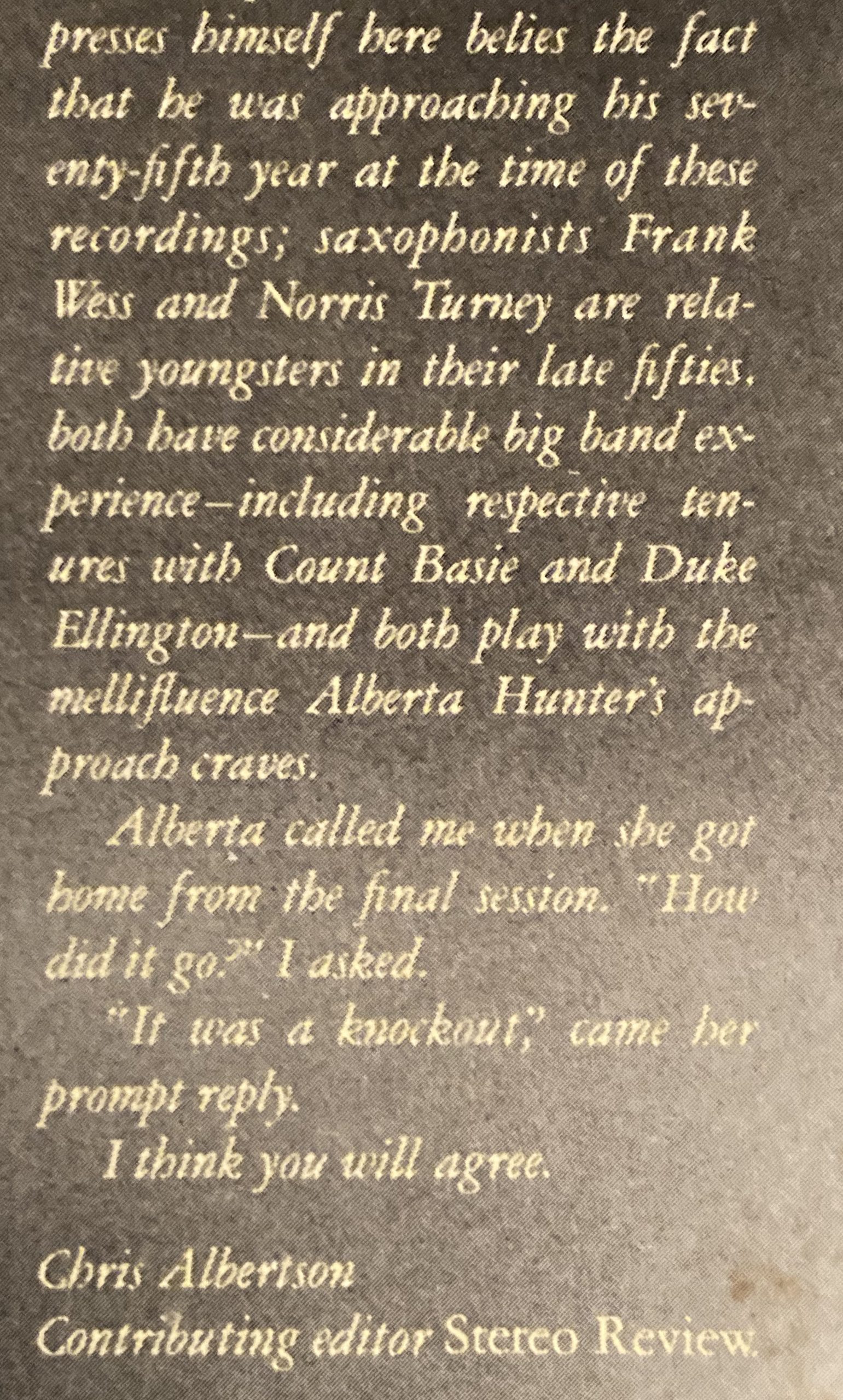
The band, propelled smoothly by one-time Ellington bassist Aaron Bell, guitarist Billy Butler, and drummer Jackie Williams, is an- chored solidly by pianist Gerald Cook, Alberta’s accompanist and musical director since 1977. The horns represent enough jazz experience to fill several volumes of his- tory: Vic Dickenson, whose fluent trombone solos and beautiful obbli- gati seem tailor-made for Alberta, has spent some 58 of his 73 years impressing fans and influencing colleagues; the list of trumpeter Doc Cheatham’s past associates is both long and awesome, and the as- sertive eloquence with which he expresses himself here belies the fact that he was approaching his sev enty-fifth year at the time of these recordings; saxophonists Frank Wess and Norris Turney are rela- tive youngsters in their late fifties. both have considerable big band ex- perience-including respective ten- ures with Count Basie and Duke
Ellington-and both play with the mellifluence Alberta Hunter’s ap- proach craves.
Alberta called me when she got home from the final session. “How did it go?” I asked.
“It was a knockout” came her
prompt reply
I think you will agree.
Chris Albertson
Contributing editor Stereo Review
<裏ジャケ和訳>
1961年9月のある心地よい午後、シカゴのサウスサイドにあるフリーメイソンのロッジの外で、私はベテランのミュージシャンたち――ピアニストのロヴィー・オースティンやクラリネット奏者のダーネル・ハワードらを含むグループ――と共に待機していました。私たちはあるアルバムを制作しようとしており、そのために私は、この地域の輝かしいジャズの歴史を彩ったスターたちを何人も集めていたのです。私はこれを「驚きの再会」にしたかったため、誰が来るのかを誰にも明かしていませんでした。それだけに、タクシーが横付けされ、そこからアルバータ・ハンターが降りてきたとき、ダーネル・ハワードが見せた驚きは本物でした。
「アルバータ!」と彼は叫びました。「死んだんじゃなかったのか?」
「とんでもないわ、この年寄りの悪ガキめ」と彼女は笑いながら答えました。「このポンコツ車、まだまだ走れるわよ!」
それから20年近くが経ち、アルバータ・ハンターの音楽キャリアが驚くべき形で再び花開くのを目にするとき、私はよくあの時のやり取りを思い出します。私たちが最初に出会ったのは、そのわずか1ヶ月前のことでした。当時、私は彼女をゴールドウォーター記念病院の看護の仕事から何とか連れ出し、私がプロデュースしていた別のアルバムで4曲だけ歌ってもらったのです。その頃の私は、アルバータについてほとんど何も知りませんでした。ただ、彼女がジャズそのものと同じくらい長い間この世界にいて、そうそうたる顔ぶれと共に数多くの録音を残しているらしい、ということくらいでした。彼女のキャリアと同じくらい魅力的だったのは、その録音に表れているスタイルの幅広さでした――その多くは、私がコペンハーゲンで暮らしていた10代の頃から私のコレクションにあったものです。私はいつしか、彼女を一種の「ボーカル・カメレオン」のように考えるようになっていました。どんな音楽的環境にも、その声とスタイルを見事に適応させてしまうからです。レコードを通じて、私は洗練された女性歌手としてのアルバータ・ハンターを知っていました。彼女は1930年代にヨーロッパの主要都市でその芸術性を披露し、1928年のロンドン公演『ショウ・ボート』ではポール・ロブソンやサー・セドリック・ハードウィックと共演したミュージカル・スターでもありました。しかし、私が求めていたのは「クラシック・ブルース」の歌手としてのアルバータ・ハンターでした。彼女はベッシー・スミスの最大のヒット曲『ダウン・ハーテッド・ブルース』の作者であり、かつてはルイ・アームストロング、シドニー・ベシェ、フレッチャー・ヘンダーソンといった当時頭角を現しつつあったスターたちの輝かしい伴奏をバックに、その土の香りのする歌詞を歌い上げていた人物だったからです。どうやって彼女と連絡を取ったのか正確には覚えていませんが、電話帳で番号を調べるといった単純なことだったと思います。彼女が再びショービジネスの世界に関わることさえ嫌がっていたと知ったのはずっと後のことでしたが、その時、彼女にレコーディングをしてもらったことがどれほど幸運だったかを痛感しました。当時私が考えていたのは、アルバータが1954年以来看護の仕事に専念しており、ここ11年ほどレコーディングをしていないということだけでした。彼女はまだ歌えるのだろうか?と私は思いました。実際、彼女は歌えました。それも驚くほど見事に。そのため、休暇でカリフォルニアへ向かう列車に乗る際、シカゴに立ち寄ってもらい、もう一枚アルバムを制作するよう彼女を説得したほどです。残念ながら、エンジニアの無能さのせいでそのアルバムは本来リリースされるべきではない惨憺たる出来になってしまいましたが、アルバータと彼女の長年の相棒であるロヴィー・オースティンの演奏は素晴らしいものでした。それでも言っておきたいのは、66歳の小柄な体をマイクの前に置き、その見た目からは想像もつかない力強い声でブルースを歌い上げた彼女に初めて接したとき、私は感銘を受け驚かされましたが、このアルバムを制作した85歳近い彼女の歌声には、それ以上に圧倒されたということです。私がこう言うのは、アルバータ・ハンターがその年齢にしては驚くほど上手に歌うから(もちろん、実際にそうなのですが)ではありません。単純な事実として、彼女は以前よりも今の方が……アルバータとは長年にわたり連絡を取り合っていましたが、友情が始まった当初、私は彼女に「たまには演奏活動をしてみるのも悪くないのでは」とそれとなく勧めたことがありました。しかし彼女は頑として聞き入れようとしませんでした。一度決めたら絶対に曲げない性格だと分かっていたので、それ以上説得するのはやめました。アルバータは看護師の仕事に全身全霊を捧げていました。実際、病院側が彼女を退職させるまで(病院は彼女がすでに12年も前に定年を迎えていたことを知りませんでした)、どんなに強く誘っても、彼女を社交の場に引っ張り出すことなど不可能だったのです。彼女が看護師という役割から一歩外に出る姿を再び目にしたのは、1970年代初頭のたった一度きりでした。それは、歌手ヴァレリー・シンプソンの自宅で、デンマークのテレビ局による彼女のインタビュー撮影を私が手配した時のことでした。彼女がその話に乗ったのは、それが海外向けの番組だったからです。彼女は、国内で注目を浴びると病院に本当の年齢が知られてしまう恐れがあるため、あえてジャズの表舞台から遠ざかっているのだと認めていました。やがてゴールドウォーター記念病院を退職することになったアルバータは、何か別の生きがいを見つけなければならないと悟ったのです。
「のんびりした生活を送ろうと決めた途端、活力を失って衰えていく友人や同僚をあまりにも多く見てきました」と彼女は言う。「働くのをやめること、それこそが最悪の選択なのです」 「人生を気楽に過ごすということは、つまり、ただ『生きる』ということだ」。1977年10月、アルバータ・ハンターは、ニューヨークのグリニッジ・ヴィレッジにあるバーニー・ジョセフソン経営のこぢんまりとしたナイトスポット「ザ・クッカリー(The Cookery)」への6週間の出演依頼を快諾しました。その後の彼女の活躍は、まさに伝説として語り継がれることになります(彼女はその後も「ザ・クッカリー」での公演を続けました)。本作は、エンターテイナーのスターとして劇的な復活を遂げたアルバータにとって、コロンビア・レーベルからの2枚目のアルバムとなります。1枚目(JS 35553)は、ジェラルディン・チャップリンとアンソニー・パーキンスが主演したロバート・アルトマン製作・アラン・ルドルフ監督の映画『リメンバー・マイ・ネーム(Remember My Name)』のサウンドトラックであり、アルバータが手掛けた音楽と歌唱は、作品の中で最も高い評価を集めました。あのアルバムの制作は、映画のサントラという性質上、アルバータとプロデューサーのジョン・ハモンドにある種の制約を強いるものでしたが、それでもなお、コロンビアでの49年ぶりとなるセッションは素晴らしい成果を生み出しました。今回のアルバムは、過去2年半にわたり「ザ・クッカリー」を訪れた数多くの観客が楽しんだステージと同様に、より多彩な楽曲で構成されています。
バンドは、かつてエリントン楽団でベースを弾いたアーロン・ベル、ギタリストのビリー・バトラー、ドラマーのジャッキー・ウィリアムズがスムーズな推進力を生み出し、1977年以来アルバータの伴奏者兼音楽監督を務めるピアニストのジェラルド・クックがしっかりと全体を支えています。ホーン・セクションの面々は、それだけで何冊もの歴史書が書けるほどの豊かなジャズの経験を誇ります。流麗なトロンボーン・ソロと美しいオブリガートでアルバータの歌に完璧に寄り添うヴィック・ディッケンソンは、73年の生涯のうち約58年を捧げ、ファンを魅了し同業者に影響を与え続けてきました。トランペットのドック・チーサムが過去に共演してきた顔ぶれは実に豪華で長く、本作で見せる自己主張に満ちた雄弁なプレイは、録音当時彼が75歳を迎えようとしていたことを感じさせません。サックス奏者のフランク・ウェスとノリス・ターニーは50代後半という「若手」の部類に入りますが、二人ともカウント・ベイシーやデューク・エリントンの楽団に在籍した経験を含め、ビッグ・バンドでの豊富なキャリアを持っています。そして彼らは、アルバータ・ハンターのスタイルにふさわしい、甘美で滑らかな音色で演奏しています。 ……たまらない魅力。
最後のセッションを終えて帰宅したアルバータから電話があった。「どうだった?」と私が尋ねると、
彼女は即座にこう答えた。
「最高に素晴らしかったわ」
きっとあなたも同感してくれるはずだ。
クリス・アルバートソン
『ステレオ・レビュー』誌 寄稿編集者
※訳文の制作にはGoogleドライブとGoogle翻訳のお世話になりました。

コメント